-
High heating efficiency and fast production pace. It allows energy to penetrate quickly into the metal workpiece, avoiding the drawbacks of traditional heating methods such as "external heating and internal cooling."
Fast heating speed: Compared with power frequency induction heating equipment, the time required to heat the same workpiece to the target temperature can be shortened by 20%-30%, making it especially suitable for "rapid preheating" and "pre-forging heating" scenarios in mass production. High thermal efficiency: Induction heating directly acts on the workpiece through electromagnetic induction, and heat loss is only concentrated in the equipment's own heat dissipation. The overall thermal efficiency can reach over 85%, far higher than resistance furnaces (approximately 60%) and oil-fired furnaces (approximately 55%).
Less oxidation and burning loss: The heating process can be carried out in a closed or semi-closed environment, reducing contact between the workpiece surface and air, thus reducing the amount of oxide scale generated by 30%-50%, lowering material waste and subsequent cleaning costs.
-
Digital control ensures precision and adapts to diverse application needs. The "digital" aspect is the core difference between this equipment and traditional analog medium-frequency equipment, achieving precise control of the heating process through digital chips and software algorithms.
Precise parameter control: Temperature control accuracy reaches ±1℃, and the power adjustment range supports stepless adjustment from 5% to 100%, meeting the strict parameter requirements of different materials (such as steel, copper, and aluminum) and different processes (such as quenching, tempering, and annealing).
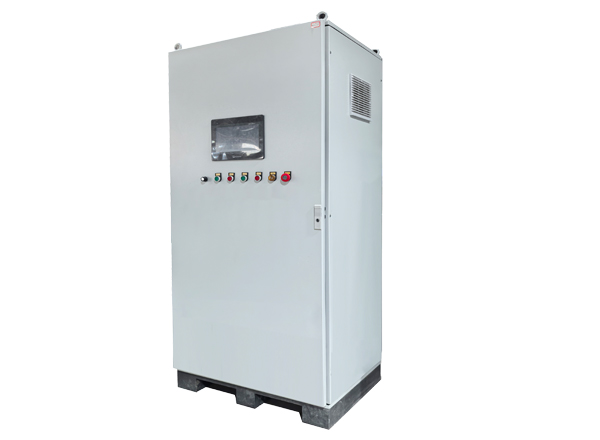
Convenient and intelligent operation: Equipped with a touch screen or PLC control system, it can preset 10-20 sets of heating programs, allowing for one-button parameter recall. Some equipment supports remote monitoring and fault alarms, reducing manual supervision costs.
Flexible load adaptation: It features automatic load matching. When the workpiece size or material changes, the equipment can automatically adjust the output frequency and power, avoiding equipment overload or uneven heating caused by load mismatch.
-
Stable and reliable operation, low maintenance costs. Industrial production demands high equipment continuity, and the 200kW digital medium-frequency induction heating equipment prioritizes "long lifespan and low failure rate" in its hardware selection and structural design.
Durable core components: Utilizing imported IGBT power modules and high-frequency capacitors, it offers strong resistance to impact, far exceeding traditional thyristor modules.
Efficient cooling system: Equipped with a water circulation cooling system, it can precisely control the temperature of core components (e.g., IGBT module temperature ≤60℃), preventing downtime due to overheating. Some equipment supports cooling water quality monitoring, reducing the risk of scale buildup and blockage.
Comprehensive safety protection: Built-in multiple protection functions including overvoltage, overcurrent, overtemperature, phase loss, and short circuit protection. When an abnormality occurs, the power supply is instantly cut off, protecting both the equipment and the operator.
-
The energy-saving effect is significant, making the energy efficiency of the equipment a key factor in enterprise selection. This equipment reduces energy consumption and pollution through multiple design features.
High energy utilization rate: Compared with traditional resistance furnaces, it saves 25%-35% of electricity when heating the same workpiece.
The heating process does not produce smoke or exhaust gas, eliminating the need for supporting smoke and dust removal equipment, thus reducing environmental protection investment and subsequent maintenance costs.



 en
en  cn
cn  jp
jp  ko
ko  de
de  es
es  it
it  ru
ru  pt
pt  vi
vi  th
th  pl
pl 




 GS-ZP-50