Contact Us
Automatic Induction Hardening Production Line For Drive Shafts

Automatic Induction Hardening Production Line For Drive Shafts

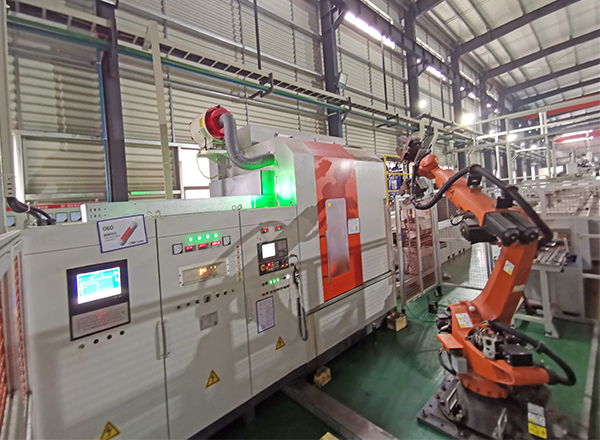
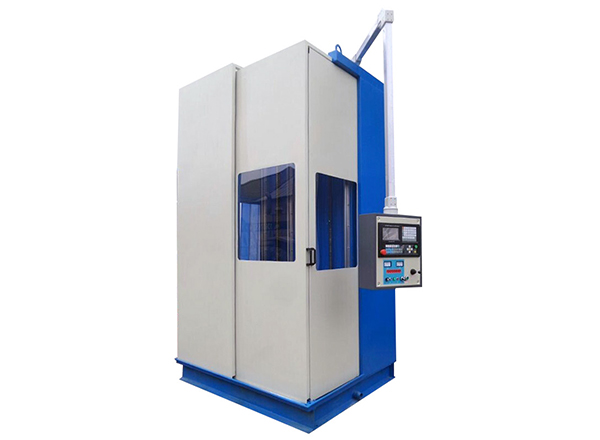
As a core transmission component in automobiles, wind power, rail transit, and construction machinery, the surface wear resistance, fatigue strength, and dimensional stability of the drive shaft directly determine the reliability and service life of the entire machine. This automatic induction hardening production line for drive shafts, relying on advanced induction heating technology and an intelligent control system, is specifically designed for the surface strengthening process of shaft-type parts. It achieves fully automated operation from feeding, positioning, hardening, and cooling to inspection and unloading, addressing the industry pain points of traditional hardening processes such as excessive manual intervention, large parameter fluctuations, high deformation rates, and high energy consumption. It provides an integrated solution for the mass production of high-quality drive shafts.


Send Inquiry     

Advantages of automatic induction hardening production line for drive shafts

To address the differentiated hardening requirements of various functional areas of the drive shaft, such as the journal, spline section, and sealing section, the production line is equipped with an ultra-high-frequency induction heating system and a servo precision positioning module.  Utilizing the "skin effect" of induction heating, heat is precisely concentrated on the surface of the part.  Heating power, dwell time, and feed speed can be flexibly adjusted to achieve precise control of the hardened layer depth (0.5-1.5mm) and surface hardness (HRC50-62). For example, the journal section of an automotive drive shaft can be set with a deeper hardened layer to improve wear resistance, while the spline section parameters are optimized to balance strength and toughness, preventing heat diffusion to non-hardened areas and effectively ensuring that the performance of each part meets design standards. Simultaneously, synchronous stretching and symmetrical scanning processes are employed, along with a profiled induction coil design, to control the straightness error of shaft-type parts to ≤0.5mm/m, significantly reducing the risk of quenching deformation.

Features of automatic induction hardening production line for drive shafts

  • The production line integrates digital IGBT inverter power supplies, intelligent robotic arms, automatic guidance and positioning devices, and a continuous conveying system, enabling a continuous operation mode with "one-button start and unattended operation."

  • During the loading phase, the workpiece is automatically aligned by guide wheels, ensuring that the deviation between the driveshaft center and the induction coil axis is ≤0.5mm. The entire process of heating, stretching, quenching, and cooling is completed synchronously during processing, eliminating the need for manual transfer. This results in a 3-4 times increase in efficiency for multi-section quenching of a single driveshaft compared to traditional intermittent processes. Equipped with 50 sets of preset process parameter storage functions, it supports flexible switching between workpieces with shaft diameters of Φ20-300mm and lengths up to 6 meters.  Changeover adjustments are quick and efficient, adapting to the needs of medium to large-scale flexible production. With an energy conversion rate of over 85%, it reduces ineffective energy consumption by 20%-30% compared to traditional medium-frequency equipment, significantly lowering production costs during long-term operation.

  • A comprehensive "monitoring-feedback-adjustment" quality control system has been established, equipped with testing equipment such as infrared thermometers, online hardness testers, and laser profilometers.  This system collects data on quenching temperature, hardness values, and geometric tolerances in real time. Temperature control accuracy reaches ±5℃, and the data is uploaded to the central control system in real time, automatically generating traceability reports. When parameters exceed the preset range, the system immediately triggers an alarm and shuts down, effectively preventing the release of defective products.
  • By employing an alternating water-air controlled cooling process and a high-pressure water mist cooling system, a cooling rate of ≥250℃/s is achieved, ensuring complete transformation from austenite to martensite while reducing quenching stress. This fundamentally solves the industry problem of cracking and deformation in drive shafts made of materials such as 42CrMo, resulting in a product yield rate consistently above 99.8%.


Need A One-stop Solution?
Please contact us for details.
Products
Contact Us
  • Tel:+86-371-60983870
  • E-mail:info@gslipai.com
  • Mobile:+86-18937640479
  • Add: No. 101, 1St Floor, Unit 1, Building 72, International Medical Industrial Park, North Of Wutong Road, East Of Nuanquan Road, Xuedian Town, Xinzheng, Zhengzhou, Henan, China
Quick Links