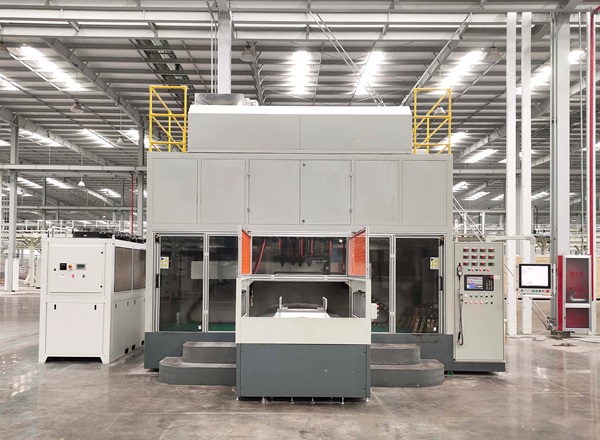
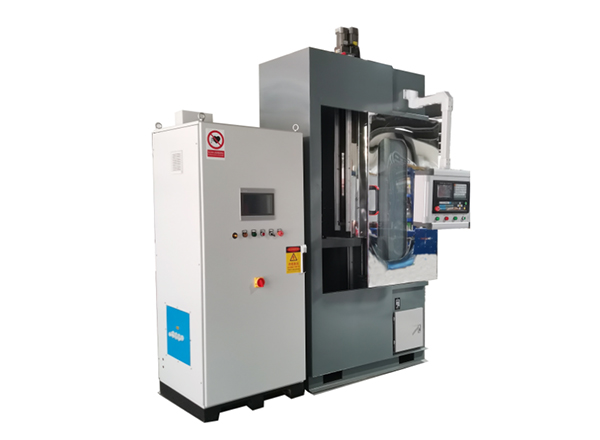
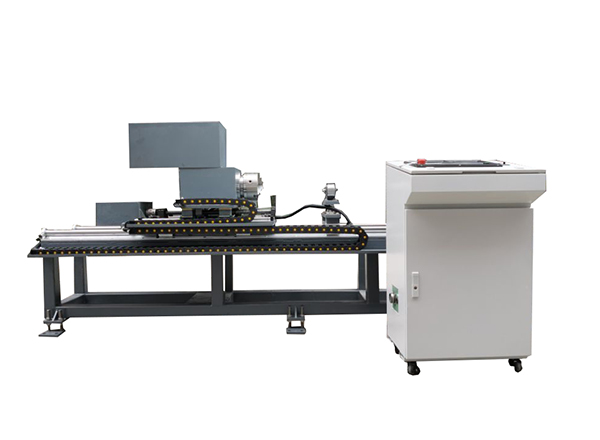
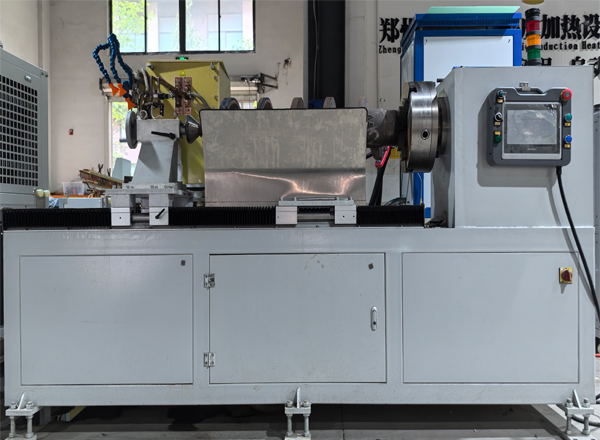
The crankshaft hardening machine is a specialized CNC induction heat treatment system tailored for crankshaft components used in internal combustion engines, construction machinery, air compressors, and similar sectors; it serves as a critical piece of equipment in automotive component and power equipment production lines. As a core transmission component of the engine, the crankshaft is subjected to prolonged alternating torsional forces, friction, and impact loads. Critical areas—such as journals, fillets, and oil seal surfaces—are highly susceptible to wear and fatigue cracking, factors that directly determine the engine's overall service life and operational stability. Utilizing electromagnetic induction heating principles to replace traditional carburizing and furnace-based through-hardening processes, this equipment performs targeted, localized surface hardening on key zones like main journals, connecting rod journals, fillets, and oil seal sections. It enhances surface hardness, wear resistance, and bending fatigue strength while maintaining the crankshaft core's toughness, thereby addressing issues related to wear and fracture. Equipped with a CNC system, the machine enables automated loading and unloading, multi-station synchronous hardening, and full traceability of process parameters, meeting the demands for intelligent, high-volume production of diverse crankshaft specifications for passenger vehicles, commercial vehicles, and construction machinery.

The machine bed features an integral welded structure made of thick-walled steel plate and has undergone dual stress-relief aging treatments; it offers high rigidity and excellent vibration resistance, ensuring no deformation during long-term operation.
The front end is equipped with a high-precision pneumatic/hydraulic self-centering chuck, while the rear features a free-floating tailstock; this setup accommodates crankshafts of varying lengths, automatically compensates for thermal deformation, and prevents bending or warping during the quenching process. A servo-driven rotation mechanism ensures constant-speed rotation during heating, guaranteeing a uniform hardened layer.
It utilizes a new-generation IGBT solid-state inverter power supply featuring stepless power regulation and automatic frequency tracking, allowing for seamless switching between medium-frequency and high-frequency heating modes based on crankshaft diameter and hardening depth requirements. Compared to traditional vacuum-tube power supplies, it offers over 30% greater energy efficiency and faster heating response, while supporting multi-channel independent power output to meet the needs of simultaneous multi-journal quenching. Multiple sets of custom-designed, low-profile contour-following inductors enable the simultaneous quenching of all main journals, connecting rod journals, and fillets in a single operation, eliminating the need for repeated clamping.
A servo-controlled CNC slide unit ensures precise inductor positioning with a repeatability of ≤±0.02 mm; heating time, power, and cooling flow rate can be independently adjusted for each heating station to meet the specific processing requirements of different crankshaft models.
Equipped with an independent, closed-loop constant-temperature cooling system for the quenching fluid—featuring high-precision flow sensors and temperature control modules—the machine enables real-time regulation of fluid temperature, spray pressure, and flow rate. This prevents defects such as crankshaft deformation or cracking caused by excessive temperature gradients.
The system integrates filtration, heat dissipation, and impurity purification functions, allowing the quenching medium to be recycled. This reduces consumable costs while meeting workshop environmental standards. It utilizes separate spray circuits for journal and fillet hardening, applying tailored cooling processes to specific areas to ensure a uniform hardening depth and eliminate soft-spot defects.
An integrated industrial PLC and touchscreen CNC system supports the storage of multiple process recipes, enabling one-touch switching between machining programs for passenger vehicle, commercial vehicle, and construction machinery crankshafts..
The system features real-time temperature monitoring, fault alarms, automatic processing data storage, and process parameter traceability. It supports integration with external MES (Manufacturing Execution System) platforms to meet the connectivity requirements of smart factory digital production lines. The intuitive, all-Chinese visual interface ensures ease of use, minimizes manual setup errors, and results in a low equipment failure rate.